Best Fire Damage Reconstruction Companies in Los Angeles (2026)
Key Takeaways
- Restoration and reconstruction are two different jobs. Mitigation firms stabilize the property, extract water, and remove soot and smoke residue. Reconstruction rebuilds what burned. Some companies do both well. Most do one well and the other adequately. Knowing which you are hiring is the whole decision.
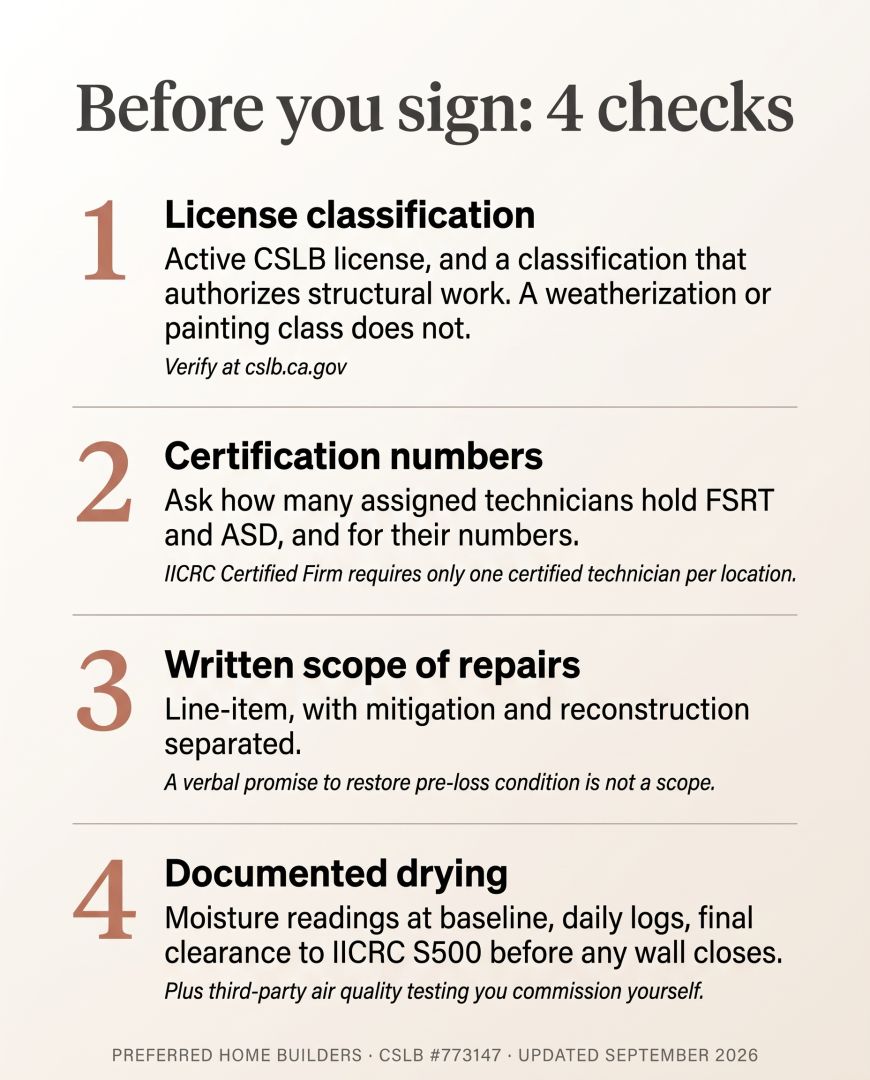
- The "IICRC Certified Firm" badge means less than the marketing implies. Per the IICRC's own FAQ, a IICRC Certified Firm needs current liability insurance, one active certified technician per location, a signed code of ethics, and a $199 annual renewal. It is a floor, not an audit. Ask which technicians hold Fire and Smoke Damage Restoration Technician (FSRT) and Applied Structural Drying (ASD) certifications, and how many.
- The fire standard everyone cites does not cover wildfires. ANSI/IICRC S700, the first fire and smoke standard, was published on January 2, 2025. Its own scope statement excludes wildfires, demolition, and reconstruction. If a firm tells you S700 governs your Eaton Fire rebuild, they have not read it.
- The Eaton Fire destroyed 9,419 structures and damaged 1,076 more across Altadena and Pasadena. The Palisades Fire destroyed 6,845 and damaged 975. Both were contained on January 31, 2025. That volume reshaped this market, and it is why capacity now matters as much as craft.
- Verify the license class, not just the license number. A licensed, bonded, and insured contractor can still hold a license that does not authorize structural work. Run every firm through the CSLB license lookup and read the classification line. We found several LA firms advertising structural damage repair on licenses that do not cover it.
- Most of a fire loss is water. Firefighting water and water sprinklers soak framing, insulation, and drywall. Secondary damage and mold usually cost more than the flame did. Structural drying under IICRC S500 is the step that decides whether you rebuild once or twice.
- You are entitled to a written scope. Ask every bidder for a line-item scope of repairs before you sign. A verbal promise to return your home to pre-loss condition is not a scope.
The short answer
The best fire damage reconstruction companies in Los Angeles are the ones that can prove three things: an active California contractor license in a classification that actually authorizes structural work, documented IICRC certifications held by named technicians rather than a logo in the footer, and a written scope of repairs that separates restoration from full reconstruction line by line.
Our shortlist below is built on that test. Seven firms, each strong at a different part of the job. Read the whole list before you call anyone, because the firm that is right for a two-room kitchen fire in Van Nuys is rarely the firm that is right for a total loss in Altadena.
The 7 best fire damage reconstruction companies in Los Angeles
How this list was built. We checked every firm's California contractor license against the CSLB public record, confirmed the license classification actually authorizes the work advertised, and recorded which certifications each company publishes rather than which ones it implies. We did not rank on review counts. Review counts measure marketing spend as much as craftsmanship.
Transparency note: this guide is published by Preferred Home Builders, and we appear at number two. We placed ourselves second because the firm at number one does something we do not: large-scale emergency mitigation. Every credential below is checkable, including ours. Verify each one yourself before you sign anything.
1. ATI Restoration (best for large or total losses)
The biggest verified operation working in Greater Los Angeles, and the only firm on this list with independently documented performance during the January 2025 fires.
- CSLB License #1075543, active. Classifications include B General Building, C22 Asbestos Abatement, and C21 Building Moving and Demolition. That matters. C22 means the asbestos-containing materials and hazardous materials work they advertise is actually authorized on their license, which is not true of every firm marketing abatement in this city.
- Founded 1989. More than 50 regional offices across 30-plus states, seven of them in Southern California.
- During the Eaton and Palisades response, ATI deployed over 1,000 personnel across 500-plus residential and commercial projects, and received the inaugural Innovative Contractor of the Year Award at the 2026 ACCESS Conference for that work.
- Names the insurance carriers it works with directly, including State Farm, Farmers, Travelers, Chubb, USAA, and Liberty Mutual.
- Serves residential, commercial, multifamily, schools, government, healthcare, hospitality, and retail.
- 24/7 emergency dispatch, board-up, water extraction, structural drying, mold remediation, odor control, contents pack-outs, and full reconstruction.
Why it leads: when a fire takes a whole block, the constraint is not skill. It is crews, equipment, and the ability to hold a schedule while 400 other homeowners are calling the same number. ATI's Los Angeles office is built for that.
Where it is not the right call: a single-family rebuild where you want the owner of the company in your kitchen making decisions. Scale cuts both ways.
2. Preferred Home Builders (best for the rebuild itself)
A family-owned design-build general contractor in its thirtieth year, and the firm on this list whose work starts where mitigation ends.
- CSLB License #773147, active, licensed, bonded, and insured. Family-owned since 1996, with more than 3,000 completed projects.
- Specializes in full rebuilds and fire damage reconstruction for homeowners recovering from the Eaton Fire, with active work in Altadena, Pasadena, and across Greater Los Angeles.
- Handles permits, code upgrades, plan check, and inspections end to end, which is the part of a rebuild that actually consumes the calendar.
- Design-build delivery with a free 3D design session, so the scope of repairs and the finished house are decided before framing rather than during it.
- Published project timelines: 1 to 3 weeks for assessment and scoping, 2 to 8 weeks for cleanup coordination, 6 to 14 months for the reconstruction itself. Public timelines are rare in this trade and worth something.
- Two appearances on HGTV's Help! I Wrecked My House, and a public portfolio of more than 100 documented Los Angeles projects.
Why it is second and not first: Preferred Home Builders is a licensed general contractor, not an IICRC Certified Firm. It does not self-perform emergency water extraction, soot removal, or certified technicians' mitigation work. On a fresh loss you will want a mitigation firm on site within hours, and that is not this. What Preferred Home Builders does is the part almost every homeowner underestimates: taking a stabilized shell through design, permits, structural integrity repairs, International Building Code compliance, and back to pre-loss condition or better.
Who it is right for: anyone past the mitigation phase who is now facing a twelve-month rebuild and wants one contract, one project manager, and one set of drawings. Scope and process are published on the fire reconstruction service page, and a free assessment is available across LA and Ventura County.
3. BELFOR Property Restoration (best for complex commercial recovery)
The oldest and largest restoration organization operating here, with capabilities no independent firm can match.
- Founded 1946, more than 500 offices worldwide. The Southern California office sits at 4955 E Hunter Ave in Anaheim and explicitly covers Orange County, Greater Los Angeles, and Downtown Los Angeles.
- States IICRC Certified Firm status and OSHA-trained personnel.
- Does both mitigation and reconstruction, including general contracting.
- Runs a dedicated environmental division for asbestos-containing materials and lead-based paint.
- Capabilities that are genuinely rare: document recovery, electronics restoration, and machinery decontamination. If your loss includes records, servers, or production equipment, this is the short list of one.
- Serves government, healthcare, education, corporate, hospitality, and industrial clients. 24/7 national hotline.
One thing to ask for: BELFOR's Los Angeles page does not publish a CSLB number. Request it in writing and check it before signing, exactly as you would with a firm one hundredth their size.
4. Protech Construction and Restoration (best for institutional and multifamily)
An Anaheim-based operation with the broadest institutional sector list we found anywhere in this market.
- CSLB License #1133745, active, classifications B General Building and C39 Roofing.
- Serves sectors most firms will not quote: senior living, student housing, commercial high-rise, multifamily, schools, healthcare, hospitality, retail, and government.
- Publishes asbestos-containing materials and lead-based paint abatement, board-up and tarping services, temporary power and HVAC, mold remediation, and Trauma and Crime Scene Remediation.
- Offers pre-loss assessment and consulting, which almost nobody does. If you manage a portfolio, a documented pre-loss baseline is the single cheapest thing you can buy before you need it.
- 24/7/365 response from an Anaheim base covering Orange County and Greater Los Angeles.
Note on the name: there are two unrelated Southern California companies using "Protech." This one is protechconstruction.com in Anaheim. Brown's Protech Construction in Arcadia is a separate company with a separate license. Confirm which one you are talking to.
5. SERVPRO of San Gabriel / Temple City (best certification transparency)
Narrow coverage, but the most honest credential disclosure we found, and a useful benchmark for judging everyone else.
- The only firm in this review that names its full technician stack rather than a badge: IICRC Certified Firm, plus Water Damage Restoration Technician (WRT), Fire and Smoke Damage Restoration Technician, Applied Structural Drying, Applied Microbial Remediation Technician, and Health and Safety Technician.
- Board-up and roof tarping services, structural drying, odor control, pack-outs with safe storage, mold remediation, and construction services.
- 24/7 dispatch. Residential and commercial.
- Located at 4961 Santa Anita Ave in Temple City, near Alhambra and the San Gabriel Valley.
Two caveats, stated plainly. Coverage is genuinely local, so this is not the firm for Pacific Palisades or Agoura Hills. And every SERVPRO is an independently owned franchise. Certifications, licensing, and reconstruction capability vary from one franchise to the next, so do not assume a neighboring franchise carries the same credentials. Use the corporate location page rather than a third-party listing.
6. First To Respond Restoration (best independent in the San Fernando Valley)
The rare independent that publishes an actual certification number instead of a logo.
- CSLB License #1018174, active since September 2016, classification B General Building.
- Publishes IICRC Certified Firm #158246. Two firms in this entire review published a verifiable firm number. This is one of them.
- Covers Van Nuys, Reseda, Northridge, Encino, Sherman Oaks, Woodland Hills, Tarzana, Burbank, Calabasas, and West Hills, plus Ventura County.
- Fire and smoke damage restoration, water damage restoration, odor elimination, mold remediation, sewage, and biohazard work including drug lab, hoarding, and rodent decontamination. That range is unusual, and it means they have been in worse buildings than yours.
- Names State Farm, Allstate, and Farmers among the insurance carriers they work with. Claims 60-minute response, 24/7.
One flag: their site states "25+ years" in one place and "20+ years" in another. Neither reconciles with a 2016 license. Use the license date as the fact and ask about the rest.
7. Built Well Restoration & Construction (best small-operator record)
The cleanest paperwork of any small firm we checked, which is a better signal than it sounds.
- CSLB License #991932, active, classification B General Building, first issued April 2014.
- Its stated "over 11 years in the insurance restoration industry" is the only longevity claim in this entire review that reconciles exactly with its license record. Everyone else rounds up.
- Mitigation and reconstruction as separate named service lines: fire and smoke, water mitigation, mold remediation, and pack-outs.
- Covers all of LA County and Ventura County from Glendale and Burbank. Open 24/7. Built Well Restoration & Construction publishes less than the larger firms, which is worth knowing going in.
The trade-off: thin published detail. No sector list, no IICRC firm number, no named technicians. Ask for all three on the first call. A small firm that answers those questions directly is often a better experience than a large one that answers them with a brochure.
Other firms operating in this market
Several other companies market fire damage restoration and reconstruction in Los Angeles and Orange County, including Save The Day Restoration, Maxi Serve Restoration & Construction, Allied Restoration, Absolute Maintenance & Consulting, Urgent One Restoration, and FastFix Restoration. We did not include them in the ranked list, and their absence is not a judgment on their workmanship. It reflects what we could verify from public records at the time of writing.
Apply the same test to any of them, and to us. Pull the license number. Read the classification line. Confirm the classification authorizes structural work if structural work is what you are buying. It takes ninety seconds at the CSLB license lookup and it is the most useful ninety seconds you will spend on this project.
Restoration or reconstruction: the distinction that decides everything
Here is the thing nobody explains on day one, and it costs people months.
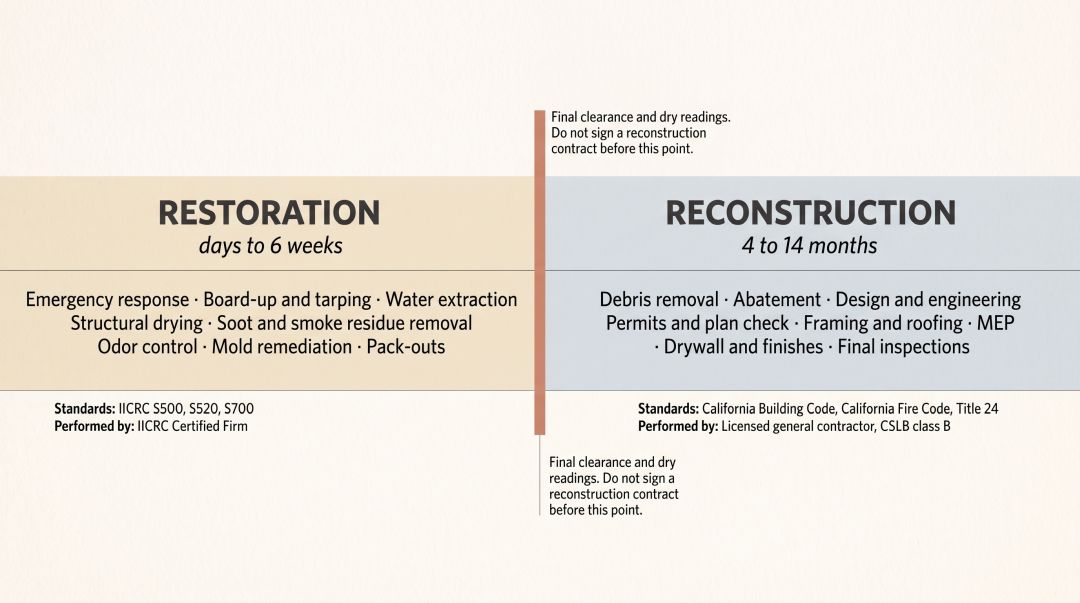
A fire loss has two halves. Restoration, sometimes called mitigation, is emergency work: emergency response, board-up, tarping services, water extraction, structural drying, cleaning and decontamination, smoke residue removal, odor control, and mold remediation. It is governed by IICRC standards and performed by certified technicians. It typically runs days to weeks.
Reconstruction is construction: debris removal, framing, roofing, mechanical, electrical, plumbing, drywall, finishes, permits, and code upgrades. It is governed by the International Building Code, the International Fire Code, and California's Title 24. It is performed by a licensed general contractor. It runs months.
| | Restoration / mitigation | Reconstruction ||---|---|---|| **Goal** | Stop the damage getting worse | Return the property to **pre-loss condition** || **Governing standards** | **IICRC S500**, **ANSI/IICRC S520**, **IICRC S700** | **International Building Code**, **International Fire Code**, Title 24, local amendments || **Who performs it** | **IICRC Certified Firm** with **certified technicians** | **Licensed** general contractor (CSLB B classification) || **Typical duration** | 3 days to 6 weeks | 4 to 14 months || **Typical scope** | **Water extraction**, **structural drying**, **soot** and **smoke residue** removal, **odor elimination**, **mold remediation**, **pack-outs** | **Debris removal**, structural repairs, **full rebuilds**, **design-build**, **permits**, finishes || **Paid by** | **Insurance claim**, often billed directly | **Insurance claim** plus, frequently, owner funds for upgrades || **What goes wrong** | Rushing the drying, so mold arrives in month three | Starting without a full **scope of repairs**, so change orders arrive in month six |
The practical version: some companies do both. Some do one and subcontract the other without telling you. Ask directly. Which of these two phases do you self-perform, and who does the other one? The answer tells you more than any review page.
Common belief: hire one company and the whole thing is handled. Reality: it can be, and there are real advantages to a single contract. But a firm that is excellent at emergency mitigation is not automatically excellent at a fourteen-month rebuild with a plan check, and the reverse is just as true. Why it matters: the reconstruction phase is where 80 percent of the money and 90 percent of the calendar live.
What January 2025 changed about hiring in this city
Two fires, same morning.
The Eaton Fire started at 6:18 PM on January 7, 2025, burned 14,021 acres across Altadena and Pasadena, destroyed 9,419 structures, damaged 1,076, and killed 19 people. The Palisades Fire started that same morning at 10:30 AM, burned 23,448 acres through Pacific Palisades, destroyed 6,845 structures, damaged 975, and killed 12. Both were fully contained on January 31.
More than 16,000 structures destroyed in 24 days, in one county.
Three consequences you are living with right now, whether you know it or not.
Capacity became a credential. Before 2025, choosing a restoration firm in LA was mostly about craft. Now it is also about whether they can staff your job in a market where every qualified crew is committed. Ask any bidder how many active projects their assigned project manager is carrying. Six is normal. Fifteen is a scheduling problem you will pay for.
Permits became the long pole. LA County's rebuilding program commits to a first residential plan review within 10 business days and subsequent reviews within 5, and waives fees for qualifying owner-occupants who owned and lived at the property before January 7, 2025. The City of LA's One Stop Rebuilding Center at 1828 Sawtelle Blvd commits to initial permit review within 30 days. Those are real improvements. They are also why a contractor who is fluent in the process finishes a year ahead of one who is learning it.
Out-of-state firms arrived, and some left. A disaster of this size draws contractors from everywhere. Many are excellent. Some registered a California entity in the weeks after the fire. A license issued in 2025 is not disqualifying, but pair it with a "serving LA for 25 years" headline and you have a question worth asking.
What IICRC certification actually proves, and what it does not
This is the section that will save you the most money, so here it is straight.
The Certified Firm badge is a floor
To become an IICRC Certified Firm, a company needs current liability insurance, at least one active certified technician per location, a completed application with a signed code of ethics, a $25 application fee, and a $199 annual renewal. That is the published requirement, from the IICRC's own FAQ.
Read that again. One certified technician. Per location.
A fifty-person company can hold the badge with one certified person on staff. The badge is genuinely meaningful as a minimum standard, because it proves insurance and a code of ethics. It is not the crew-wide vetting most marketing implies.
So ask a better question: how many of the technicians who will be on my property hold FSRT, and can you send me their certification numbers? You can verify any firm at the IICRC Certified Firm lookup.
The certifications that matter on a fire loss
| Certification | What it covers | When you need it on site ||---|---|---|| **Fire and Smoke Damage Restoration Technician (FSRT)** | Scoping, mitigation, cleaning, deodorization, subrogation, documentation of fire-damaged structures and contents | Every fire loss. Non-negotiable. || **Water Damage Restoration Technician (WRT)** | Water damage categories, extraction, drying principles | Every fire loss, because of firefighting water || **Applied Structural Drying (ASD)** | Drying structures, systems, and materials in place | Any loss where framing or subfloor got wet || **Applied Microbial Remediation Technician (AMRT)** | Mold remediation under **ANSI/IICRC S520** | Any loss discovered late, or dried slowly || **Health and Safety Technician (HST)** | Jobsite safety, **OSHA** compliance, hazard control | Any occupied or **commercial** property || **Trauma and Crime Scene Remediation (TCST)** | Biohazard decontamination | Fatalities, or long-vacant properties |
Worth knowing: FSRT has no prerequisites. A technician can hold it without holding WRT. That is not a scandal, it is just a reason to ask about both.
The standards, and the one most people get wrong
- IICRC S500, fifth edition, 2021. The water damage restoration standard. Covers categories of water, drying technology, antimicrobials, structural and HVAC restoration, documentation. This is the standard your structural drying should be performed to, and the one to name in your contract.
- ANSI/IICRC S520, fourth edition, 2024. The mold remediation standard. Containment, chemical treatments, post-remediation verification.
- ANSI/IICRC S700, first edition, published January 2, 2025. The first consensus standard for fire and smoke damage restoration. Covers assessment of fire residues and odors, work plans, contractor qualifications, HVAC and air conveyance, odor management, contents restoration, and post-restoration evaluation.
Now the part that matters in Los Angeles. S700's own scope statement says it does not comprehensively address wildfires, chemical or industrial fires with environmental hazards, specialized buildings such as healthcare and laboratories, or demolition and reconstruction.
Wildfires. Excluded.
So if you lost a home in Altadena or Pacific Palisades, S700 is a useful reference for the smoke and residue work inside a surviving structure, and it is not the governing document for your rebuild. Your rebuild is governed by the building code and your policy. A contractor who tells you otherwise is quoting a press release they have not read past the headline.
That gap is real, it is recent, and the S700 consensus body is already revising the standard. Until then, the honest answer is that wildfire loss sits in a space the industry has not fully standardized yet, which is exactly why individual firm competence matters more here than a certificate on the wall.
Smoke residue: four types, four different jobs
Restoration companies sort smoke residue into four working categories. You will hear all four in your first site visit.
| Residue type | What produces it | What it looks like | What it takes ||---|---|---|---|| **Dry smoke** | Fast, high-oxygen, high-temperature fires. Paper, wood | Powdery, gray, brushes off | Dry sponging and HEPA vacuuming first. Wet cleaning too early smears it in || **Wet smoke** | Slow, low-oxygen, smoldering fires. Plastics, rubber | Sticky, dense, black, smears, strong lingering odor | Solvent-based cleaning, heavy labor, frequently the hardest of the four || **Protein residue** | Kitchen fires. Burned organic matter | Nearly invisible, yellow-brown film, discolors paint and varnish | Full degreasing of every surface, and it is the worst for **odor elimination** || **Fuel oil soot** | Furnace puff-backs, oil-burning equipment | Greasy black film over everything | Specialized cleaning agents, frequently a contents **pack-out** |
Be careful with this taxonomy, and here is why we are telling you rather than hiding it. These four categories are industry working vocabulary. They are practically useful and they map to real cleaning decisions. They are not, however, a scientific classification backed by NIST, the EPA, or peer-reviewed literature. Any contractor who presents them as laboratory-grade categories is overselling. A good one uses them as shorthand and then tests.
What the research does say about post-fire residue
The evidence base for wildfire residue inside homes is newer and more useful than most homeowners realize.
A June 2026 evidence review from the National Collaborating Centre for Environmental Health found char detected in 57 percent of smoke-affected homes and 2.8 times more likely on windowsills, a median level of priority PAHs in house dust 16 percent higher than unaffected homes, and median heavy metals 15 percent higher six months after the fire. Wet wiping reduced PAHs by 62 to 71 percent. Laundering removed 48 percent. Combined vacuuming, mopping, and dusting cut airborne VOCs by 19 to 50 percent.
A 2023 study in Science Advances (Li et al., DOI 10.1126/sciadv.adh8263) found something more pointed: indoor surfaces absorb smoke compounds and then act as emission sources afterward, re-releasing them into the air. Portable air cleaners dropped VOC levels, but concentrations returned to pre-treatment levels roughly 30 minutes after the units were switched off. Surface cleaning achieved 39 percent removal that still held 12 hours later.
Translation: air scrubbers alone do not fix a smoke problem. They make the air readable while the actual work is done on surfaces. A scope of work that is heavy on industrial grade fans and hydroxyl generators and light on hand cleaning has the ratio backwards.
Odor control: what the three methods actually do
- Thermal fogging heats a deodorizing solvent into a fog that penetrates the same porous materials smoke penetrated. Effective, and it requires the space to be vacated.
- Hydroxyl generators produce hydroxyl radicals that neutralize odor compounds. Slower than ozone, and safe to run in occupied spaces, which is the main reason to choose them.
- Ozone treatment is the most aggressive option and the one to ask hard questions about. Ozone is a respiratory irritant. The space must be unoccupied, including pets, and properly aired before reentry. It can also degrade rubber and some plastics. Effective when used correctly. Used carelessly, it creates a second problem.
None of the three substitutes for removing the source. Odor treatment applied over uncleaned soot buys you about six weeks.
The half of a fire loss that is actually water
Ask anyone who has been through it. The fire took two hours. The water took the house.
Firefighting water and water sprinklers put hundreds or thousands of gallons into a structure in a short window. That water goes into wall cavities, under subfloor, into insulation, and into the crawlspace, and it does not evaporate on its own in a closed building.
Secondary damage is what follows: swelling and delamination of engineered materials, rusting of fasteners and connectors, buckled flooring, and mold colonization, which in Southern California conditions can begin within 24 to 48 hours.
The American Red Cross is direct about the consequence: drywall and insulation saturated by fire hose water generally cannot be dried while maintaining structural integrity and mold resistance. They come out.
What competent structural drying looks like, and what to require in writing:
- Documented moisture readings at baseline, taken with both penetrating and non-penetrating meters, on a mapped grid rather than a few spots.
- A written drying plan with target moisture content by material, performed to IICRC S500.
- Daily readings logged and shared with you, not just with the adjuster.
- Equipment sized to the load. Industrial grade fans and dehumidifiers specified by calculation, not by whatever was on the truck.
- Final clearance confirmed by readings that match dry-standard, before anything closes up.
- Third-party air quality testing and independent air quality measurements where mold was present, paid for by you rather than by the remediation firm. This is the single most valuable $600 in the whole project.
The rule worth tattooing somewhere: never let a contractor close a wall they have not shown you a dry reading for. Reconstruction over wet framing is the most expensive mistake in this entire industry, and by the time it surfaces, everyone involved has been paid.
Safety and regulatory standards that apply to your job site
A burned building is a regulated hazardous environment, not a construction site with soot on it. Six frameworks govern the work, and asking about them is the fastest way to tell a professional operation from a truck with a logo.
OSHA Construction Standards, 29 CFR 1926. The construction standard covering demolition, fall protection, respiratory protection, and hazard communication on your rebuild. Reference: OSHA 29 CFR 1926. The general industry standard, OSHA 29 CFR 1910, applies to non-construction operations at the same property.
Cal/OSHA fire cleanup requirements. California goes further than federal rules, and the state's worker health and safety during fire cleanup guidance is the clearest document in this entire field. It requires elastomeric air-purifying respirators with HEPA filters for ash and soot exposure, with N95s acceptable only in limited circumstances, and cites specific sections on asbestos, demolition, unstable structures, heat illness, confined spaces, and carbon monoxide. If a crew is working your Eaton Fire property in cloth masks, that is a Cal/OSHA violation and a signal about everything else they do.
EPA NESHAP asbestos rule. Under the Asbestos NESHAP, a thorough inspection for asbestos-containing materials is required before demolition or qualifying renovation, along with notification to the delegated agency, wetting of regulated material, leak-tight containment and disposal, and a trained on-site representative. Thresholds are 260 linear feet, 160 square feet, or 35 cubic feet. Any Los Angeles home built before the mid-1980s should be surveyed before debris removal begins, full stop.
EPA Lead RRP rule. Anyone paid to disturb painted surfaces in homes and childcare facilities built before 1978 must be a certified firm using certified renovators. Reference: EPA Lead Renovation, Repair and Painting Program. Much of Altadena, Pasadena, and the older Valley housing stock is pre-1978. Lead-based paint is not a technicality here.
Building and fire codes. Rebuilds are permitted under the current code cycle, not the one the house was built to. California's 2025 Title 24 took effect January 1, 2026, which means the California Building Code (Part 2, derived from the International Building Code) and the California Fire Code (Part 9, derived from the International Fire Code) both apply in their 2025 editions. For properties in a high fire hazard severity zone, Chapter 7A ignition-resistant construction requirements drive real cost. Budget for code upgrades. They are not optional and they are frequently not fully covered.
Contractor licensing. Every firm doing structural work needs an active CSLB license in a classification that authorizes it. Verify at the CSLB license lookup, which also discloses complaint history.
The question that flushes out a weak bid: which code cycle did you price this against, and did you include Chapter 7A? A contractor who has been rebuilding in the fire zones answers in one sentence. One who has not will change the subject.
What a fire damage reconstruction project actually looks like
Six phases. The timeline assumes a substantial residential loss in Los Angeles; commercial and multifamily run longer.
| Phase | What happens | Typical duration | Who performs it ||---|---|---|---|| **1. Emergency response** | **24/7** dispatch, safety assessment, utility shutoff, **board-up**, **tarping services**, securing the site | Hours to 3 days | Mitigation firm || **2. Assessment and documentation** | **Moisture readings**, residue testing, **asbestos-containing materials** and **lead-based paint** survey, photo documentation, **insurance-friendly documentation**, **scope of repairs** | 1 to 3 weeks | Mitigation firm and contractor, with the adjuster || **3. Mitigation** | **Water extraction**, **structural drying**, **soot** and **smoke residue** removal, **cleaning and decontamination**, **mold remediation**, **odor control**, **pack-outs** to **safe storage** | 2 to 8 weeks | **IICRC Certified Firm** || **4. Demolition and abatement** | Selective demolition, **debris removal**, **hazardous materials** abatement, exposure of structure for engineering review | 1 to 4 weeks | Licensed abatement and demolition || **5. Design and permits** | Structural engineering, drawings, plan check, **permits**, **code upgrades**, **design-build** decisions | 4 weeks to 6 months | General contractor and design team || **6. Reconstruction** | Framing, roofing, mechanical, electrical, plumbing, insulation, drywall, finishes, final inspections, **packing and moving** back | 4 to 12 months | General contractor |
Where projects stall, in order of frequency: waiting on the insurance scope to be agreed, waiting on plan check, and waiting on a structural engineer's letter. Notice that none of the three is about construction. A contractor who manages those three actively is worth more than one who builds slightly better walls.
A hard-won piece of advice: do not sign a reconstruction contract before the mitigation scope is complete and the drying is signed off. You cannot accurately price a rebuild through a wall you have not opened.
How the insurance side actually works
Your insurance claim is a parallel project running alongside the physical one, and it is where most of the stress lives.
What a competent contractor does on the claim side:
- Produces insurance-friendly documentation: line-item estimates in the format carriers expect, photo documentation tied to each line, and daily logs.
- Works with all major insurance companies and, on mitigation, will frequently bill your insurance directly so you only cover your deductible.
- Meets the adjuster on site rather than emailing about it.
- Documents supplemental scope the moment a wall opens, not at the end.
Four things to know that carriers do not volunteer:
- Additional living expenses are a separate coverage. Most policies cover a temporary rental property or temporary location and reasonable living expenses while your home is uninhabitable, subject to a limit and a time cap. Find your ALE limit in week one, not month six, because it governs how much schedule risk you can absorb.
- Pack-outs are billable and worth doing right. Inventoried packing and moving of contents to safe storage, with a documented inventory, protects both the contents and your claim. Undocumented pack-outs create disputes at settlement.
- Code upgrade coverage is usually a separate, limited endorsement. Ordinance or law coverage pays for bringing the rebuild up to current code. It is typically capped at a percentage of the dwelling limit. On a Chapter 7A rebuild in a fire hazard zone, that cap gets tested.
- A restoration contract is not the same as your claim. Read any assignment of benefits or direct-billing authorization before you sign it. Understand what you are assigning and what you can still control.
We are contractors, not adjusters or attorneys, and this is general information rather than advice about your policy. For an independent starting point, the U.S. Fire Administration's after a fire guidance covers the first 24 hours, insurance, valuing property, and replacing documents, and it is free.
How to choose: the factors that actually separate firms
| Factor | Adequate | Strong | Why the gap matters ||---|---|---|---|| **Licensing** | Has a CSLB number | Active license in a classification that authorizes structural work, clean complaint history | A C-class license does not authorize a rebuild || **Certification** | "IICRC certified" in the footer | Named technicians with **FSRT** and **ASD**, firm number you can verify | The badge requires one technician || **Scope** | A total price | Line-item **scope of repairs** separating mitigation from **full reconstruction** | Ambiguity always resolves against the homeowner || **Drying** | "We'll dry it out" | Documented **moisture readings**, written drying plan to **IICRC S500**, daily logs, **final clearance** | Wet framing behind new drywall || **Verification** | Their own air test | **Third-party air quality** testing you commission | Nobody should grade their own work || **Insurance handling** | "We work with all carriers" | Named carriers, Xactimate estimating, adjuster met on site | Documentation quality drives your settlement || **Capacity** | "We can start Monday" | Named project manager with a stated active project count | Starting fast and finishing slow is the common failure || **Permits** | "We'll handle permits" | Names the reviewing department and quotes a realistic plan check duration | Schedule accuracy starts here || **Reconstruction depth** | Subcontracts the rebuild quietly | Self-performs or names the GC in the contract | You should know who is building your house |
Five questions for every bid. Ask them in this order, and write the answers down.
- Do you self-perform mitigation, reconstruction, or both? Who does the part you do not?
- How many technicians on my job will hold FSRT, and what are their certification numbers?
- What is your assumed drying standard and how will I see the daily readings?
- Which code cycle did you price against, and did you include Chapter 7A?
- Who is my project manager, and how many active projects are they carrying right now?
Why homeowners choose Preferred Home Builders for a fire rebuild
Written plainly, because this is the section of the article with an interest.
- Thirty years of Los Angeles code fluency. Family-owned since 1996, more than 3,000 completed projects, and day-to-day work in LADBS and LA County plan check. On a rebuild, permit fluency is not administrative. It is months.
- Reconstruction depth, not a mitigation upsell. We do not run water extraction trucks, and we say so. What we do is take a stabilized property through design, engineering, permits, code upgrades, structural damage repair, and back to pre-loss condition or better. If you need mitigation today, call a firm from this list and call us for what comes after.
- One contract, one project manager. Design-build delivery with a free 3D design session, so the scope of repairs and the finished house are agreed before framing starts rather than negotiated during it.
- Active in the fire-affected communities. Current Eaton Fire rebuild work across Altadena and Pasadena, plus Greater Los Angeles and Ventura County.
- Verifiable credentials. CSLB License #773147, licensed, bonded and insured, with a public portfolio of more than 100 documented projects and two appearances on HGTV's Help! I Wrecked My House.
- Published timelines. 1 to 3 weeks to assess and scope, 2 to 8 weeks for cleanup coordination, 6 to 14 months for reconstruction. We publish them because a contractor who will not give you a range on day one will not give you one on day ninety either.
Related work sits close to a fire rebuild more often than people expect. A roof is frequently the first structural element to fail in a fire, and we cover replacement on the roofing contractors page. Many rebuilds turn into whole-home projects once the walls are open, which is covered under interior remodeling. Total losses become ground-up work, handled through our home builder service. And families rebuilding for a changed household frequently add square footage at the same time, which is covered on the room additions page.
If you are still choosing a contractor, our guide to what to look for when hiring a general contractor in Los Angeles covers license and insurance verification in detail, and the 2026 Los Angeles remodeling cost guide gives current per-square-foot ranges you can sanity-check a rebuild estimate against. For a wider view of the market, see our roundup of top home renovation companies in the San Fernando Valley.
A free assessment and free in-home assessment are available across LA and Ventura County. Start at request an estimate, or read what past clients said on the testimonials page.
Frequently asked
Keep reading
All storiesWhat Is the Average Cost of Home Remodeling in Los Angeles in 2026?
Cost
How Much Does a Room Addition Cost in Los Angeles Per Square Foot?
Room Addition
Is It Worth Remodeling a Home in Los Angeles vs. Buying New? (2026)
For most LA homeowners in 2026, remodeling beats buying new: you keep your Prop 13 tax basis and locked-in mortgage rate, and skip 8–10% in round-trip transaction costs. Here’s the full math.
Get a fixed-price estimate for your remodel.
One team for design and build, one schedule, one price. Free consultation across greater Los Angeles.