What Is the Average Cost of Home Remodeling in Los Angeles in 2026?
Key Takeaways
- Home remodeling in Los Angeles costs roughly $175 to $700 per square foot in 2026, depending on how deep the work goes. A down-to-studs gut renovation can run past $1,000.
- A mid-grade whole-home remodel of a 2,000 sq ft house typically lands between $400,000 and $700,000. Cosmetic updates on the same house often finish under $180,000.
- Soft costs are the line most people forget. Architectural plans, engineering, Title 24, and plan check add 12% to 20% on top of construction.
- Material costs in Southern California are running roughly 10% to 16% above 2025 because of tariffs on lumber, steel, aluminum, appliances, and fixtures.
- The published "average cost per square foot" numbers you find online disagree by a factor of five. That is not because the market is chaotic. It is because nobody agrees on the denominator. More on that below.
- Budget a 10% to 20% contingency fund. In LA's pre-1970 housing stock, that money gets spent.
The short answer
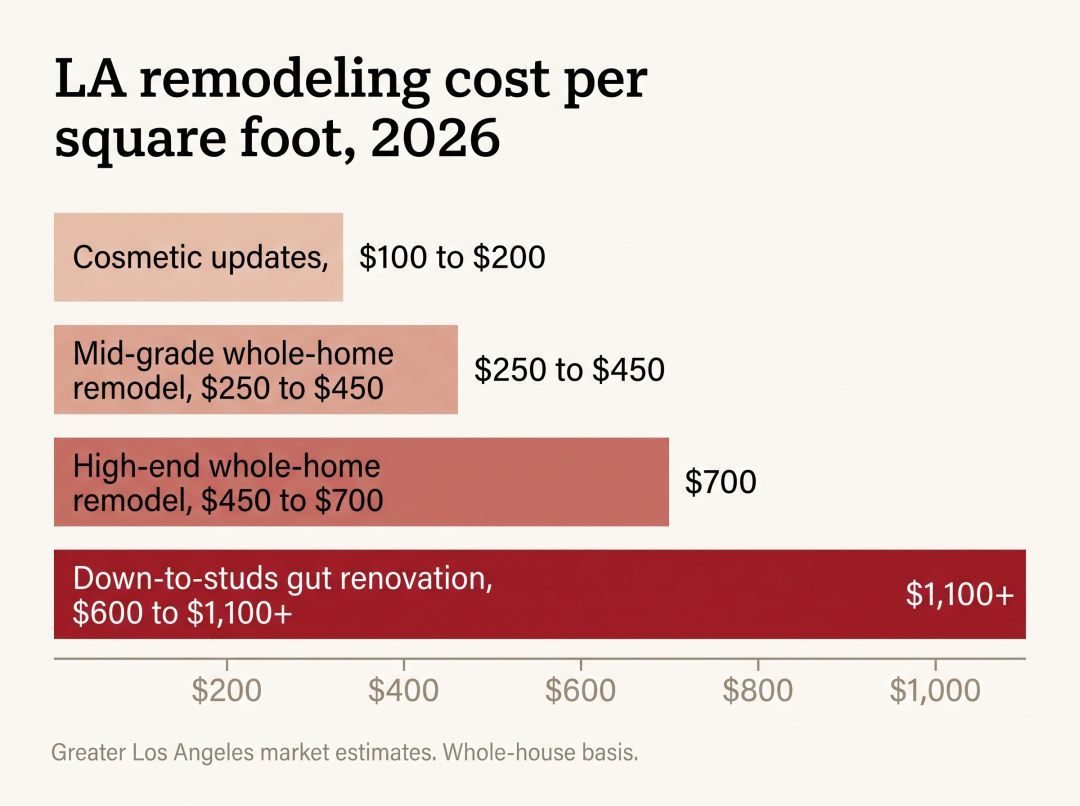
Most Los Angeles homeowners in 2026 spend somewhere between $175 and $700 per square foot on a home remodeling project. Cosmetic updates sit at the bottom of that band. A full home renovation with new systems, structural changes, and custom finishes sits at the top. A down-to-studs gut renovation on an older LA property can exceed $1,000 per square foot once seismic requirements and hidden repairs are priced in.
For a typical 2,000 square foot house, that works out to somewhere between $150,000 and $1.4 million. Which is a useless range if you are trying to plan. So the rest of this article is about narrowing it.
[Visual placeholder: hero infographic, "LA remodeling cost per square foot by scope, 2026" with four horizontal bars]
Why every "average cost" number you have read is wrong
Here is the thing nobody in this industry says out loud.
Search "average cost of home remodeling in Los Angeles" and you will find one contractor quoting $150 to $350 per square foot for a full gut renovation, and another quoting $600 to $1,100 per square foot for the same words. That is not a small disagreement. That is one firm saying a job costs a third of what another firm says it costs.
Both numbers can be accurate. They are measuring different things.
The disagreement is in the denominator. Some firms divide the total project cost by the square footage of the whole house, including the bedrooms nobody touched. Others divide it only by the area actually under construction. A $500,000 remodel that gutted the kitchen, two baths, and the living room in a 2,400 sq ft house is either "$208 per square foot" or "$625 per square foot," and neither figure is a lie.
Why it matters: when you compare two bids using cost per square foot, you are almost certainly comparing two different denominators. Ask every contractor the same question: what square footage did you divide by? The answer reorders the bids more often than the price does.
That question alone will save you more money than any negotiation tactic.
Los Angeles home remodeling cost per square foot in 2026
Here are the working numbers for greater LA this year, measured on a whole-house basis. These are market estimates, not quotes, and they move with home condition, design complexity, and neighborhood.
| Scope | Cost per square foot | What it actually includes ||---|---|---|| **Cosmetic updates** | $100 to $200 | Paint, flooring, light fixtures, refaced or refinished cabinets, no layout change, no permits in most cases || **Mid-grade whole-home remodel** | $250 to $450 | New kitchen and bathrooms, some **structural changes**, partial **electrical upgrades** and **plumbing upgrades**, mid-tier **finish materials** || **High-end whole-home remodel** | $450 to $700 | **Custom cabinetry**, **natural stone**, **designer fixtures**, moved walls, new **HVAC upgrades**, full systems replacement || **Down-to-studs gut renovation** | $600 to $1,100+ | Demolition to framing, all-new plumbing, electrical, HVAC, insulation, windows, seismic retrofitting, often a new roof |
[Visual placeholder: comparison table rendered as a styled graphic for social sharing]
Total budgets by square footage
| Home size | Cosmetic updates | Mid-grade whole-home remodel | High-end / gut ||---|---|---|---|| 1,200 sq ft | $60,000 to $150,000 | $300,000 to $540,000 | $540,000 to $1.1M || 2,000 sq ft | $90,000 to $220,000 | $400,000 to $700,000 | $700,000 to $1.8M || 3,000 sq ft | $130,000 to $320,000 | $600,000 to $1.1M | $1.1M to $2.7M |
Two caveats worth more than the table itself.
Cosmetic budgets rarely apply to the whole house. Most homeowners doing cosmetic updates do three or four rooms, not twelve. Real-world spend usually lands between $40,000 and $120,000.
The high-end column assumes an older house. A 1952 Valley ranch and a 2004 build with the same square footage are not the same project. One needs a panel, copper repipe, and shear walls before a single tile goes down.
What LA adds that the rest of America does not
The national picture is calmer than ours. Harvard's Joint Center for Housing Studies puts annual US homeowner improvement and repair spending at roughly $519 billion through mid-2027, growing at only 0.5% year over year, and its Remodeling Futures director has described renovation activity as "cooling" (Joint Center for Housing Studies).
Cooling nationally. Not cheap locally. Los Angeles carries costs most American markets do not.
1. Soft costs and plan check
Soft costs are everything you pay before a hammer swings. Design, architectural plans, structural engineering, energy calculations, city fees, and plan check review. In LA, budget 12% to 20% of construction cost.
| Soft cost item | Typical LA range ||---|---|| Architectural plans | $6,000 to $25,000 || Structural engineer | $3,000 to $12,000 || Title 24 energy calculations | $700 to $2,500 || Permit fees and plan check combined | $4,000 to $12,000 || 3D renderings and **interior designer** selections | $3,000 to $15,000 |
The Los Angeles Department of Building and Safety now runs at dbs.lacity.gov, with plan check submitted through ePlanLA and a public permit fee calculator. If a contractor is still sending you to the old ladbs.org address for permits, that tells you something about how current their process is.
2. Title 24 changed on January 1, 2026
This is the single most underpriced item in LA remodeling budgets right now.
California's 2025 Building Energy Efficiency Standards took effect January 1, 2026 (California Energy Commission). Title 24 applies to alterations and additions, not just new construction. Every three years the bar moves, and 2026 is a moved-bar year.
Practically, that means insulation, window performance, ducting, and equipment specs on your project are being reviewed against a code cycle that is eight months old. Bids written off 2022-cycle assumptions come back short. If your contractor cannot tell you which code cycle their scope was priced against, get a second opinion.
3. Overlays, zoning, and RSO status
Before design starts, three things need checking:
- Zoning and overlays. Pull the property on ZIMAS, the city's zoning information map. Hillside, coastal, and historic (HPOZ) designations each add weeks and dollars. Coastal review can add 6 to 20 weeks on its own.
- RSO status. If the property has any rental history, check with the LA Housing Department. Rent Stabilization Ordinance rules constrain what you can do to a unit and what happens to tenants during work, and the department runs a property lookup tool for confirming RSO status.
- HOA rules. Private restrictions on materials, roof color, and work hours can quietly reprice a project.
As Tamir Pinhas, President of Preferred Home Builders, puts it in the company's guide to LA renovation permits: "A permit is only slow when it's a surprise."
4. Seismic requirements and older housing stock
A large share of LA's single-family homes predate 1970. Once you open walls on a house that age, seismic requirements enter the conversation. Shear walls, hold-downs, and foundation bolting are not optional when you are altering the structure, and they are not cheap.
This is why the same remodel costs more in Sherman Oaks than in most of America. Not because the labor is greedier. Because the building is older and the code is stricter.
5. Impact fees on added square footage
Adding space triggers fees straight square-footage remodels never see. School impact fees apply to room additions over 500 square feet, and the city's Affordable Housing Linkage Fee can apply to projects adding more than 1,500 net new square feet. Confirm current rates with the city before you finalize a budget, since these are reset periodically.
Room-by-room: what LA homeowners actually pay
Kitchen remodel cost
A kitchen remodel is where most LA budgets start and where most of them break.
| Tier | Cost range | What you get ||---|---|---|| **Budget kitchen** | $25,000 to $45,000 | Stock cabinets, laminate or entry **quartz countertops**, big-box appliances from Home Depot or Lowe's, existing layout || **Mid-grade kitchen** | $60,000 to $120,000 | Semi-custom cabinets, quartz, quality appliances, minor layout changes || **High-end kitchen** | $120,000 to $300,000+ | **Custom cabinetry**, **natural stone** slabs, professional appliances, moved walls, **designer fixtures** |
Cabinetry alone eats 30% to 40% of a kitchen budget. Custom runs $25,000 to $80,000 before anything else is installed. Quartz countertops run $60 to $120 per square foot installed; marble runs $100 to $250.
The expensive decision is not the finish. It is the plumbing. Moving a sink costs $1,500 to $5,000. Relocating a gas range costs $500 to $2,000. Removing a load-bearing wall costs $10,000 to $30,000 and pulls in an engineer. Full breakdown in the 2026 kitchen remodel cost guide for Los Angeles, and scope options on the kitchen remodeling service page.
Bathroom remodel cost
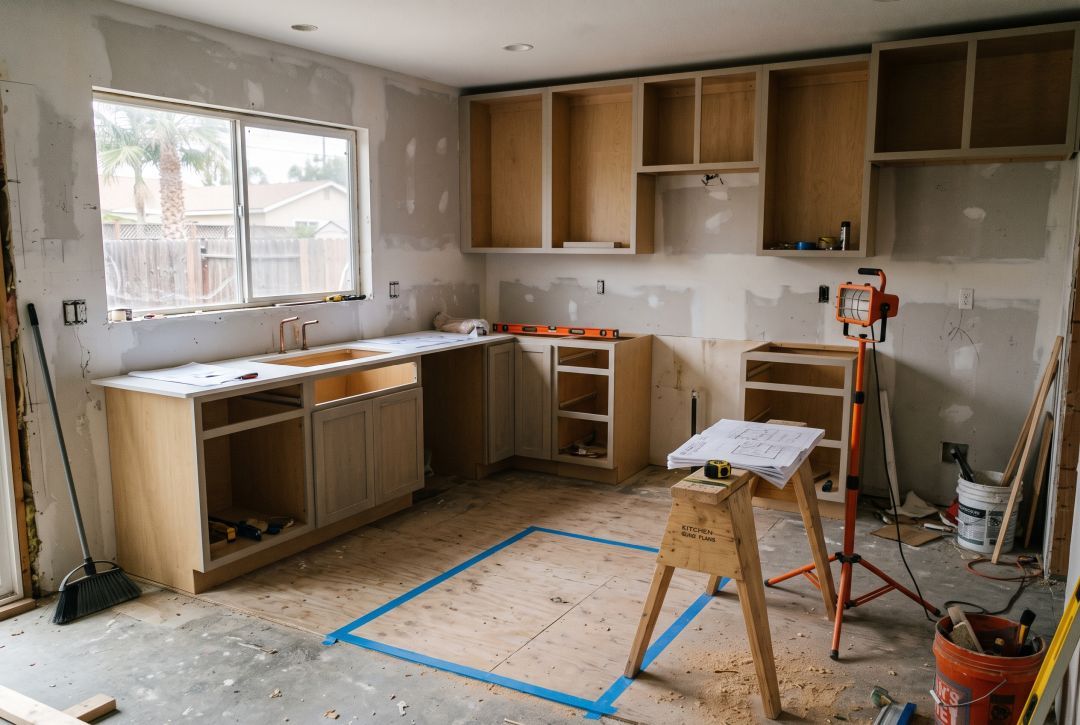
| Tier | Cost range | Typical size ||---|---|---|| Powder room | $8,000 to $18,000 | 15 to 25 sq ft || Basic refresh | $12,000 to $24,000 | 35 to 50 sq ft || **Mid-grade bathroom** | $25,000 to $45,000 | 40 to 70 sq ft || Primary bath | $45,000 to $85,000 | 75 to 130 sq ft || **High-end bathroom** | $85,000 to $250,000+ | 100 to 200 sq ft |
Per square foot, mid-tier bathroom work runs $400 to $700. Natural stone and custom millwork push it to $700 to $1,200. Bathrooms are the most expensive rooms in the house per square foot, and it is not close, because every square foot carries waterproofing, plumbing, electrical, and tile labor at once.
Keeping the existing layout saves $5,000 to $15,000. Simplifying a tile pattern cuts tile labor by 30% to 60%. See the Los Angeles bathroom remodel cost breakdown for line-item detail, and the bathroom remodeling service page for scope options.
Room additions and master suite additions
| Addition type | Cost per square foot ||---|---|| Ground-floor addition | $300 to $500 || Second-story addition | $300 to $600 || Bump-out | $400 to $700 || **Master suite addition** | $400 to $600 || Kitchen expansion | $450 to $750 |
A 500 sq ft single-story addition typically runs $150,000 to $250,000. Add a wet room and it moves to $200,000 to $300,000. Timelines run 7 to 14 months end to end for single story, 9 to 18 months for a second story. Detail in the room addition cost per square foot guide and on the room additions service page.
Garage conversion and JADUs
The cheapest square footage in Los Angeles is square footage you already own.
A garage conversion to finished living space runs $35,000 to $80,000. A full ADU with kitchen and bath runs $50,000 to $150,000. JADUs, junior accessory dwelling units carved out of existing house area, sit at the lower end because they share systems with the main dwelling.
A single-car garage usually yields 400 to 600 square feet. Ceiling height minimums and residential energy code upgrades apply. Details on the garage conversion service page.
[Visual placeholder: before and after gallery, garage conversion, Woodland Hills]
Where the money actually goes
Homeowners assume material costs dominate. On most LA projects, they do not.
| Category | Share of a typical mid-grade budget ||---|---|| **Labor costs** | 35% to 50% || Materials and finishes | 25% to 40% || Soft costs (design, engineering, permits) | 12% to 20% || **Contractor profit** and overhead | 15% to 22% || Contingency | 10% to 20% |
Licensed trades in LA bill $85 to $175 per hour. On a bathroom, labor is 40% to 60% of the number.
Why this matters for your decisions: cutting material specs saves less than people expect. Swapping a $120 per square foot quartz for a $70 one on 45 square feet of counter saves about $2,250 on a $90,000 kitchen. Cutting one week of trade labor by not moving the plumbing saves more.
The lever is layout, not finishes. Every wall you leave standing and every drain you leave in place removes labor days, inspection cycles, and risk. Quality of materials is where you should spend. Project scope is where you should cut.
The 2026 problem: material prices are moving mid-project
This is new, and it changes how you should read a bid this year.
Tariffs are pushing hard on construction inputs. Southern California residential material costs are running roughly 10% to 16% above 2025, with framing lumber up 12% to 18%, structural steel and rebar up 10% to 15%, aluminum windows and doors up 11% to 16%, kitchen appliances up 15% to 22%, and bathroom fixtures up 12% to 20%. Nonresidential construction input prices surged at a 12.6% annualized rate in the first two months of 2026. Construction wages are up over 4% year over year, with specialized trades up 9% to 11%.
What to do with that information:
- Ask how long the bid is valid. A 90-day price hold means something in 2026. A 12-month one probably is not real.
- Ask which items are allowances rather than fixed prices. Appliances and fixtures are the usual escalation points.
- Order long-lead items early. Windows, custom cabinets, and stone slabs are where both delay and price escalation live.
- Raise your contingency, do not lower your scope first. A 15% contingency fund on a moving-price year is arithmetic, not pessimism.
The cheapest bid is usually the most expensive project
Take two bids on the same kitchen. One is $78,000. One is $96,000. The $78,000 bid is fourteen line items. The $96,000 bid is sixty-one.
The gap is almost never the contractor's margin. It is scope that one bid priced and the other left out, to be sorted later through change orders, at a moment when you have no leverage because your kitchen is already demolished.
Four things to check in any proposal:
- Allowances. A $4,000 appliance allowance on a high-end kitchen is a change order with a date on it.
- Exclusions. A short exclusions list on a large project means the proposal is incomplete, not generous.
- Change-order terms. Written, priced, and approved before the work happens. Not settled at the end.
- Hidden-conditions language. Dry rot, galvanized pipe, undersized joists. A proposal that names these has met them before.
Count line items, not dollars. Preferred Home Builders' guide on how to read a fixed-price proposal makes the same point more bluntly: you are not comparing prices, you are comparing how much of the project each price includes.
Common repairs that surface after demolition in older LA homes:
| Hidden condition | Typical cost ||---|---|| Water damage and rot | $1,500 to $6,000 || Galvanized pipe replacement | $2,000 to $7,000 || Cracked cast iron drains | $2,500 to $9,000 || Wiring replacement | $1,500 to $5,000 || Undersized joists | $2,000 to $6,000 |
Return on investment: what actually pays you back
Zonda's most recent Cost vs. Value Report, the 38th annual edition covering 28 projects across 115 US markets, found that exterior replacement projects dominate ROI: garage door replacement recouped 267.7% of cost, steel entry door replacement 216.4%, and manufactured stone veneer 207.9%. A minor kitchen remodel was the highest-ranking interior project at 112.9% (Zonda). The Pacific region reported some of the strongest overall returns in the country.
Read that carefully, because the popular reading of it is wrong.
Common belief: kitchens and bathrooms are the best investment in a home. Reality: at resale, curb appeal outperforms interiors almost every time. Why: buyers price what they see before they walk in, and interior taste is subjective. Your marble is somebody else's demo cost. Why it matters: if you are remodeling to sell within two years, the money belongs outside. If you are remodeling to live there for a decade, ignore ROI tables and build what you want.
Working guidance most LA builders and agents use: keep total remodel spend to roughly 5% to 7% of home value per major project if resale matters to you. Mid-range kitchens recoup about 60% to 80% in LA; mid-range bathrooms about 70% to 80%; luxury versions of both drop to 45% to 60%.
Return on investment is a reason to choose between projects. It is a bad reason to choose whether to remodel at all.
Choosing a contractor without getting burned
Verify the license first, always
Check the license at the Contractors State License Board. The CSLB publishes both the license lookup and the contract rules, and any California home improvement work over $500 requires a written contract. And one rule worth memorizing:
A California contractor cannot ask for or accept a down payment of more than $1,000 or 10% of the contract price, whichever is less. No exceptions, including for special-order materials.
If someone asks for 30% up front, that is not a negotiating position. It is a violation.
Progress payments cannot exceed the value of work already completed. Change orders must be written and signed before work starts.
Design-build firm or architect plus general contractor?
| | Design-build firm | Architect plus separate **general contractor** ||---|---|---|| Accountability | One contract, one party | Split between two, gaps become disputes || Cost visibility | Budget and design develop together | Design finishes, then price arrives || Design ambition | Practical, constructible | Higher ceiling on originality || Speed | Faster, overlapping phases | Slower, sequential || Best for | Whole-home remodel, additions, ADUs, budget certainty | Architecturally unusual homes, hillside builds, custom design-led projects |
Neither wins universally. A design-build firm is generally better when budget certainty matters more than design ambition. An architect-led team is generally better when the house is unusual or the design is the point.
Questions that separate real bidders from optimistic ones
- What square footage did you divide by to get your cost per square foot?
- Which Title 24 code cycle did you price against?
- What is the allowance for appliances, tile, plumbing fixtures, and lighting?
- Who pulls the permits, and what is your assumption for plan check duration?
- What did you assume about the electrical panel, the supply piping, and the foundation?
- What is your change-order process, in writing?
Timeline: how long an LA remodel actually takes
| Project | Design and permits | Construction | Total ||---|---|---|---|| Bathroom remodel | 4 to 12 weeks | 3 to 6 weeks | 2 to 5 months || Kitchen remodel | 4 to 12 weeks | 8 to 14 weeks | 3 to 9 months || Garage conversion | 2 to 4 months | 2 to 4 months | 4 to 8 months || Room addition (single story) | 3 to 6 months | 4 to 8 months | 7 to 14 months || Second-story addition | 4 to 8 months | 5 to 10 months | 9 to 18 months || Full home renovation | 2 to 6 months | 4 to 9 months | 6 to 15 months |
Notice how much of the schedule happens before construction. City review, not framing, is where most LA projects lose time. Overlays add more: hillside review adds 4 to 12 weeks, historic overlay 4 to 10 weeks, coastal review 6 to 20 weeks.
Financing, briefly
Most LA remodels over $100,000 are funded through home equity lines of credit, cash-out refinancing, renovation loans, or contractor-arranged financing. Rates and terms move constantly, and the right structure depends on your equity position, your existing mortgage rate, and how long you plan to stay. Compare total cost of borrowing rather than monthly payment, and talk to a lender or financial advisor before committing. This article is not financial advice.
One practical note: lenders release renovation loan funds in draws tied to completed milestones, which needs to match your contractor's payment schedule. Reconcile those two documents before signing either.
Six mistakes that cost real money
- Budgeting construction and forgetting soft costs. Add 12% to 20%, every time.
- Skipping the feasibility check. Pull ZIMAS, check RSO status, read the HOA rules. Before design, not during.
- Choosing finishes before locking layout. Layout drives labor. Labor drives the budget.
- Treating contingency as optional. In a pre-1970 house, it is a line item, not a cushion.
- Accepting a verbal change order. Every change, written and priced, before the work.
- Pricing against last year's code. The 2025 Title 24 standards took effect January 1, 2026.
Frequently asked
Keep reading
All storiesHow Much Does a Room Addition Cost in Los Angeles Per Square Foot?
Room Addition
Is It Worth Remodeling a Home in Los Angeles vs. Buying New? (2026)
For most LA homeowners in 2026, remodeling beats buying new: you keep your Prop 13 tax basis and locked-in mortgage rate, and skip 8–10% in round-trip transaction costs. Here’s the full math.
How Much Does It Cost to Build an ADU in Los Angeles in 2026?
A 2026 guide to what it costs to build an ADU in Los Angeles: real price ranges by type, and what drives the number up or down.
Get a fixed-price estimate for your remodel.
One team for design and build, one schedule, one price. Free consultation across greater Los Angeles.