6 Best Custom Home Builders in Los Angeles for Ground-Up Builds (2026)
Home Builders
Key Takeaways
- The best custom home builder for a ground-up build in Los Angeles is the one that owns the whole chain: design, structural engineering, building permits, site work, and construction, under one construction contract you can actually read.
- Our shortlist: Preferred Home Builders for design-build ground-up homes, Diditan Group for luxury custom residences, Golden Age Builders for remodel-or-rebuild decisions, Nico Designs for design-led Beverly Hills work, Osborne Building Corporation as a Beverly Hills interview candidate, and Joel & Co. Construction for comparing construction management styles.
- Budget reality check: nationally, construction alone ran $162 per square foot in 2024 (NAHB). Published Los Angeles custom-home ranges sit at roughly $350 to $1,000+ per square foot before land. That gap is the whole story of building here.
- Plan on 14 to 30 months from first drawing to move-in. Design and permits usually eat 4 to 12 months before a shovel hits dirt.
- California's contract rules were written for remodels. The CSLB's home improvement contract rules cap down payments and require written change orders. Write those same protections into a new-build contract anyway.
- Verify before you fall in love with a portfolio. Run every finalist through the CSLB license lookup. It takes two minutes.
The short answer
If you want one team to take an empty lot, or a teardown, all the way to keys, start with a licensed design-build general contractor that has built ground-up homes in your city, not just remodeled them.
Then check three things on paper: an active contractor license, a written scope that names who handles permits and engineering, and a project schedule with real ranges in it. Everything else is taste.
Quick picks: Los Angeles ground-up home builders
Transparency note: this guide is published by Preferred Home Builders, and we list ourselves first. We're a design-build firm, so ground-up delivery under one contract is literally what we sell. We've tried to be fair to everyone else, and every claim below is something you can check yourself. Please do.
| Builder | Best for | Pricing | Key strength ||---|---|---|---|| **Preferred Home Builders** | Design-build ground-up homes | Free in-home estimate | One team for **architectural plans**, **3D design**, permits, and construction || **Diditan Group** | Luxury custom homes | Not published | States it designs, builds, and finances luxury properties || **Golden Age Builders** | Remodel-versus-rebuild decisions | Not published | **New construction** and **home remodeling** under one roof || **Nico Designs, Inc.** | Design-led Beverly Hills projects | Not published | **Preconstruction**, design, budgeting, and construction || **Osborne Building Corporation** | Beverly Hills shortlists | Not published | Luxury-market comparison candidate || **Joel & Co. Construction** | Comparing construction management | Not published | Long-running **general contractor** with custom-home services |
We didn't rank on review counts. Review counts measure marketing budgets about as well as they measure framing.
1. Preferred Home Builders: best for design-build ground-up homes
A family-owned design-build general contractor, building in Los Angeles since 1996. If you want the architect, the engineer, the permit expediter, and the builder sitting in the same meeting, this is that model.
- CSLB License #773147, licensed, bonded, and insured. More than 3,000 completed projects and a 25-person team, led by the same family since 1996.
- Builds custom luxury homes, single-family residences, teardown-and-rebuilds, two-story homes, and multi-generational estates. Details on the home builder service page.
- Free in-home design session with 3D design renderings (a $3,000 to $5,000 value when you build with them), so you see the house before anyone pours a footing.
- Handles architectural plans, permit applications, city submissions, and engineering requirements in-house, then builds what it drew.
- A dedicated project manager runs the site through every phase.
- Publishes timelines, which most builders won't: 14 to 22 months for a single-family residence, 15 to 23 months for a teardown and rebuild, 18 to 30 months for a two-story estate.
- Offices in Canoga Park and Culver City. Two appearances on HGTV's Help! I Wrecked My House.
Why it's first on this list: ground-up builds usually go wrong at the seams. The architect draws something the budget can't carry, the builder prices it late, and the owner pays for the redesign. Design-build removes that seam. PHB lays out the trade-offs in its piece on design-build versus hiring a designer and a contractor separately.
Where it's not the right call: if you already have a signed architect and finished drawings you love, you may want a pure builder or a construction manager instead. Design-build pays off most when design hasn't started.
Worth knowing: a lot of ground-up clients also want an Accessory Dwelling Unit on the same lot for parents, adult kids, or rental income. PHB scopes those together through its ADU contractors team, which is cheaper than coming back for it in year three.
2. Diditan Group: best for luxury custom homes
A luxury-focused Los Angeles builder and developer. Arie Abekasis is identified as founder, and Diditan Luxury Home Builders says it designs, builds, and finances luxury properties in Modern, Tuscan, Cape Cod, and Mediterranean styles.
- Luxury home builder and developer positioning.
- Los Angeles market focus.
- Multiple architectural styles.
- Stated financing capability, which is unusual for a builder.
Ideal for: owners planning a high-end custom residence who want a builder that lives in the luxury tier.
Before you sign: confirm the license number and classification, ask for comparable completed homes, and get in writing who carries permit responsibility. If financing is part of the pitch, have your own lender or attorney read that piece separately.
3. Golden Age Builders: best for deciding between remodeling and rebuilding
Useful when you don't know yet whether to renovate or knock it down. Golden Age Builders says its residential work runs from single bathroom refreshes to ground-up new builds, including full-gut renovations.
- Ground-up new construction plus complete-home makeovers.
- Los Angeles and Southern California focus.
- Consultation-led property and scope evaluation.
Ideal for: owners who need feasibility help before choosing demolition, an extensive remodel, or starting over.
Our take: the overlap between remodeling and new construction is useful early. Ask whether one agreement covers subcontractors, permits, design consultants, and inspections, or whether you'll be juggling three.
4. Nico Designs, Inc.: best for design-led Beverly Hills projects
A candidate for design-conscious homes in Beverly Hills and nearby luxury markets. According to Home Builder Digest, the firm primarily offers pre-construction consultation, design work, budgeting, and construction.
- Appears in Beverly Hills custom-builder research.
- Ground-up and extensive remodel experience.
- Preconstruction, design, budgeting, and construction services.
Ideal for: homeowners comparing design coordination and construction delivery on a luxury residence.
Ask for: recent projects that match your scale and architectural style. A beautiful kitchen remodel doesn't prove a firm can run a 6,000-square-foot ground-up build.
5. Osborne Building Corporation: best for a Beverly Hills specialist shortlist
A Los Angeles construction contractor that shows up in Beverly Hills builder roundups. Treat that as a reason to interview them, not as a quality guarantee (the same goes for every list, this one included).
- Named in Beverly Hills custom-home-builder research.
- Relevant to luxury-market comparisons.
- Needs direct portfolio review and project-specific scope validation.
Ideal for: owners ready to walk comparable finished ground-up homes before choosing a contractor.
Worth noting: request active license information, insurance certificates, owner references, recent project addresses, and confirmation of current capacity before you get to proposals.
6. Joel & Co. Construction: best for comparing construction management approaches
A long-running general contractor with a custom-home line. Joel & Co. Construction says it has over 50 years of experience and more than 5,000 projects across Los Angeles since 1983. Services include general contracting, custom-home building, kitchen and bath remodeling, Accessory Dwelling Units and room additions, and commercial construction.
- General contracting and custom-home building.
- A detailed proposal process covering the full scope.
- Works alongside clients' architects, engineers, and designers.
Ideal for: owners who already have an architect and want to compare how builders handle scheduling, communication, subcontractor coordination, and reporting.
The verdict: keep them on the list if the license, a recent ground-up portfolio, their permitting role, and their contract responsibilities all check out in due diligence.
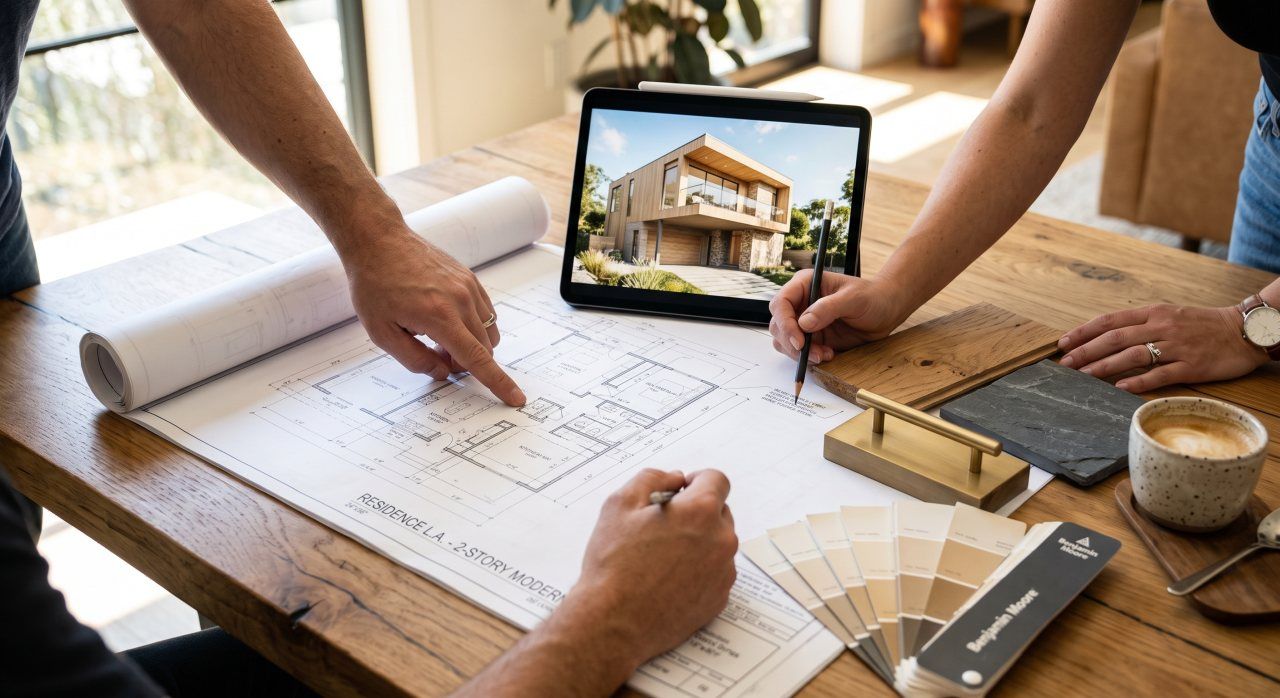
What "ground-up" actually means in Los Angeles
A ground-up build is a new house on a vacant lot or on a lot where the old house gets demolished. It's not a remodel, and it gets permitted, engineered, and taxed differently.
Most LA ground-up projects fall into one of these types:
- Teardown and rebuild. You love the street, not the house. Most common in the Westside and the Valley.
- Vacant infill lot. Rare in the city, more common in the hills and outer neighborhoods.
- Luxury custom residence. Beverly Hills, Bel Air, the Palisades, Brentwood. Design drives everything.
- Multi-generational estate. A main house plus an ADU or JADU, planned together from day one.
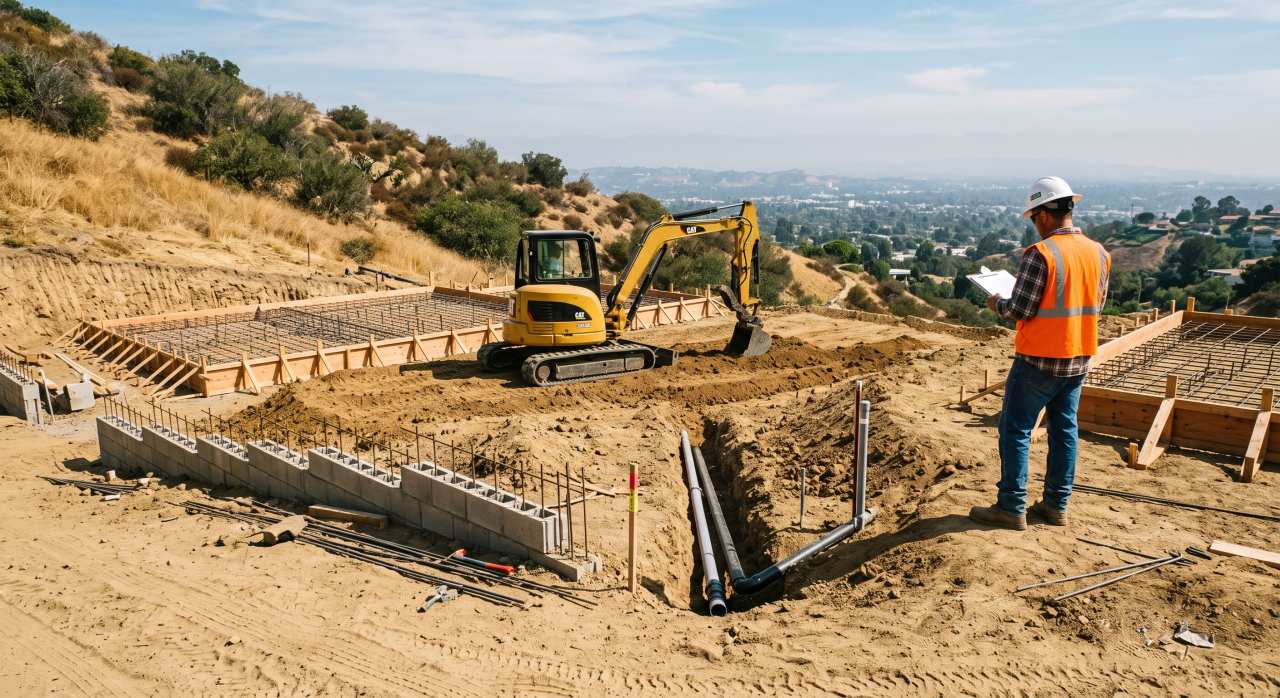
- Hillside build. Views, and a foundation budget that surprises everyone. PHB's breakdown of what a hillside lot adds in time and cost is worth reading before you buy the lot.
- Coastal build. Santa Monica, Redondo Beach, the South Bay. Extra review layers and tighter lots.
The unusual LA factor: in City of Los Angeles single-family zones, the Baseline Mansionization Ordinance limits how much floor area you can build on a lot. Your builder should know your maximum square footage before the architect draws a single room.
How much does a ground-up build cost in Los Angeles?
Short version: roughly $350 to $1,000+ per square foot for construction, before land. Standard-quality builds sit at the low end, luxury custom homes at the top.
For context, the National Association of Home Builders found the national average construction cost was $162 per square foot in 2024, on an average 2,647-square-foot home. LA runs two to six times that. Labor, land prices, seismic engineering, and permitting are why.
Here's where the money goes on a typical LA ground-up build:
| Cost bucket | What's in it | Why LA runs high ||---|---|---|| **Design and engineering** | **Architectural plans**, **structural engineering**, soils report, Title 24 energy calcs | Seismic design and hillside geology || **Permits and fees** | Plan check, **building permits**, school fees, utility fees | Multiple agencies, long review queues || **Demolition** | Removing the existing house, abatement if needed | Pre-1980 homes often need asbestos surveys || **Site work** | **Grading**, drainage, retaining walls, foundations | Slopes, soils, and tight access || **Utility connections** | Sewer, water, gas or all-electric service, power upgrades | Service upgrades and trenching in the street || **Construction** | Framing, MEP, roofing, windows, finishes | Labor costs and code requirements || **Contingency** | 10% or more of construction | Because something always turns up in the dirt |
NAHB's national breakdown backs up where the spend lands: interior finishes (24.1%), major systems rough-ins (19.2%), and framing (16.6%) are the three biggest construction categories. Site work was just 7.6% nationally. On an LA hillside, expect it to be a lot more.
Watch the allowances. An allowance is a placeholder budget for things you haven't picked yet, like tile or fixtures. Low allowances make a bid look cheap and then blow up the budget mid-build. Ask every builder to price allowances at the finish level you actually want.
Key factors when choosing a custom home builder
Pick the builder whose process fits your project, then check their paperwork. Here's what separates the good ones.
1. Delivery model
This decision shapes everything else, so it goes first.
| Model | How it works | Pros | Cons ||---|---|---|---|| **Design-build** | One firm designs and builds under one contract | Budget checked during design, one point of accountability, faster start | You need to trust the firm's design team || **Design-bid-build** | Architect designs, then builders bid | Maximum design freedom, competitive bids | Bids often come in over budget, redesign loops, blame between parties || **Construction management** | A construction manager coordinates trades and schedule, often alongside your architect | Transparency on costs, owner stays in control | More owner involvement, fees on top of trade costs |
Our opinion: for most first-time custom builders in LA, design-build is the calmer road. Design-bid-build makes more sense when design is the whole point and budget is flexible.
2. Licensing and insurance
- An active California contractor license with a B (General Building) classification.
- General liability and workers' compensation certificates naming you as certificate holder.
- A clean complaint history on the CSLB lookup.
3. Permit fluency
Who submits to LADBS, or to Beverly Hills, Santa Monica, or Redondo Beach? Who answers plan check corrections? A builder who does this weekly can save you months. PHB's guide to LA permits covers the basics.
4. Preconstruction depth
Good preconstruction means a soils report, a survey, a zoning check, and a budget, all before full drawings. It's the cheapest phase to change your mind in.
5. Contract and change order discipline
The CSLB requires home improvement contracts over $500 to be in writing, caps the down payment at $1,000 or 10% (whichever is less), and says any change to price or scope must be a written, signed change order before the work happens.
A brand-new house may fall outside the legal definition of "home improvement." Don't let that matter. Put those same protections into your construction contract anyway.
6. Warranty
Ask what the builder's warranty covers and for how long, and how warranty calls get handled after move-in. California's Right to Repair Act (SB 800) also sets defect standards and a claims process for new homes, so ask your attorney how it applies to your contract.
7. References that match your project
Two comparable completed ground-up homes, and owners who'll take your call. A builder's best remodel doesn't tell you much about their foundations.
Benefits of building ground-up instead of remodeling
A new build makes sense when no existing house can be fixed into the one you need. When it fits, the upside is real.
- A house designed for how you actually live. Layout, light, storage, and flow, all from zero.
- Current code from day one. Seismic, energy, and fire standards built in, not retrofitted.
- Lower long-term maintenance. New roof, systems, plumbing, and electrical all start their clocks together.
- Better energy performance. The 2025 California Energy Code, in effect for permit applications from January 1, 2026, expands heat pumps in new homes and pushes electric-readiness.
- Room for an ADU. You can plan the main house and the backyard unit together.
The honest counterpoint: sometimes an extensive remodel or a room addition gets you 80% of the house for half the money. PHB's remodel versus buy new guide runs those numbers for LA.
Safety and code considerations on a Los Angeles job site
A ground-up build is a regulated job site, and a good builder runs it like one. Here's what you should expect to see.
- Demolition and abatement first. Older homes can hide asbestos and lead paint. Ask for a hazardous materials survey before demolition.
- Engineered grading and shoring. Excavation next to neighbors or on slopes needs engineered plans and inspections.
- Seismic design. LA homes are engineered for earthquakes. Your structural engineering package should show it.
- Fire zone construction. In a very high fire hazard severity zone, ignition-resistant materials and defensible space rules apply and add cost.
- Coastal review. In Santa Monica, Redondo Beach, and other coastal areas, a Coastal Development Permit or local coastal review can add months.
- Jobsite safety. Fencing, fall protection, and a clean, organized site. Messy sites tend to be late sites.
Neighborhood notes: Van Nuys, Santa Monica, Beverly Hills, Redondo Beach
Every LA city has its own rules and its own headaches. Ask each builder to show you work in yours.
Van Nuys. Flatter lots and a lot of teardown potential. Watch lot configuration, zoning, parking, and utility upgrades. PHB has built here, including a Junior ADU in Van Nuys and a room addition in Van Nuys.
Santa Monica. Its own building department, coastal regulations, neighborhood design standards, and tight lots. Ask who manages city approvals, utility coordination, inspections, and site conditions.
Beverly Hills. Separate city, separate plan review, and a design review culture that takes aesthetics seriously. Budget time for it.
Redondo Beach. Coastal conditions, smaller urban lots, grading, drainage, and local review. Get a written plan for permitting, construction access, and utility work before you compare prices.
Questions to ask every builder before you choose
Ask these in the first meeting, and write the answers down.
- Who controls architectural coordination, structural engineering, demolition, utility planning, permits, inspections, allowances, change orders, and closeout?
- Is this one design-build agreement, or separate design and construction contracts?
- Can I see two comparable completed ground-up homes and talk to those owners?
- What's the project schedule, phase by phase, and what usually delays it?
- How are allowances priced, and what finish level do they assume?
- What does your warranty cover, and who do I call in year two?
- Who's my project manager, and how many active projects are they running?
Each answer should end up in the proposal and the contract, not in someone's memory of a conversation. If you're still early, PHB's guide to what to look for when hiring a general contractor in Los Angeles goes deeper on vetting.
Why homeowners choose Preferred Home Builders for a ground-up build
This is the section of the article with an interest, so we'll keep it factual.
- One roof, one contract. Architects, designers, and builders on one team, from 3D renderings and permits to final walkthrough.
- You see it before you build it. A free in-home design session and photoreal 3D design, refined until the layout and finishes are right.
- Permits handled. Applications, city submissions, and engineering requirements, run by people who do it every week.
- Thirty years in LA. Family-owned since 1996, 3,000+ projects, License
#773147, licensed, bonded, and insured. - Published timelines. Ranges by project type, confirmed after the design session, before you commit.
- Everything around the house, too. ADUs, garage conversions, and interior remodeling for the other buildings on your property.
You can browse finished work on the projects page, take a virtual tour, read client testimonials, or request a free estimate.
Frequently asked
Keep reading
All storiesWhat Should I Look For When Hiring a General Contractor in Los Angeles?
Hiring a general contractor in Los Angeles is a verification exercise, not a gut call. Four checks, about an hour, and most of the ways a remodel goes wrong disappear.
Top Home Renovation Companies in the San Fernando Valley (2026 Guide)
A 2026 buyer’s guide to the top home renovation companies in the San Fernando Valley: eight licensed, verified firms ranked and compared — and how to choose between them.
Fire Damage Reconstruction Contractors in Los Angeles: The Complete 2026 Guide
How to choose fire damage reconstruction contractors in Los Angeles: the fire restoration process, licensing, insurance assistance, costs, and wildfire rebuilds.
Get a fixed-price estimate for your remodel.
One team for design and build, one schedule, one price. Free consultation across greater Los Angeles.